As Austin goes into Stage 1 watering restrictions as part of their Drought Contingency Plan, here’s how we can help save water for the future.
The value of a water drop is appreciated more by the third-world’s middle and poor classes. So much to learn from the bucket baths vs. unlimited minutes, if not hours, of shower baths and from storing water in containers with the once-an-hour-a-day water supply vs. 24×7 uninterrupted availability.
Diminishing western and eastern ghats and fertile agricultural lands turning into concrete jungles in the name of real estate in India is the cause of abnormal weather conditions. I can sense Austin (Texas) going down the same road:
Remember, “A true conservationist is a man who knows that the world is not given by his fathers, but borrowed from his children.” One has no right to abuse natural resources in the name of freedom. Being responsible is the name of the game.
Are you taking care of your mental and physical health? Do your deeds and thoughts tend towards some self-love than just self-abuse? Recently, I have realized the need for self-care. This thought process should start from within you. This is to all who are more prone to pleasing others and only know to care for others.
There will be ups and downs. But, the indifference meted out to you should not pull you down but help you expand as an ocean–keep the pleasures and pains as treasures hidden underneath, be strong, create the same crests and troughs producing beautiful rhyme and rhythm come what may.
In this process, stay away from negativity– participate in discussions that inculcate a positive thought process, a room for open discussions where you are celebrated and encouraged towards positive stimulation to the brain. As a result, Bala and I become small donors to two or more nonprofits every year. You are responsible for the community’s health and, in turn, the world you live in. So I decided to stop talking about politics on social media. This doesn’t mean I don’t care, but I act to make the change.
The takeaways:
Eat healthily,
Exercise,
Don’t overthink,
Think positively,
Stay away from abusers and abusive thoughts
Last but not least, don’t fix when things aren’t broken.
If you are happy, continue being happy. Not all are in the same boat; not all pieces of advice is to everyone 😉
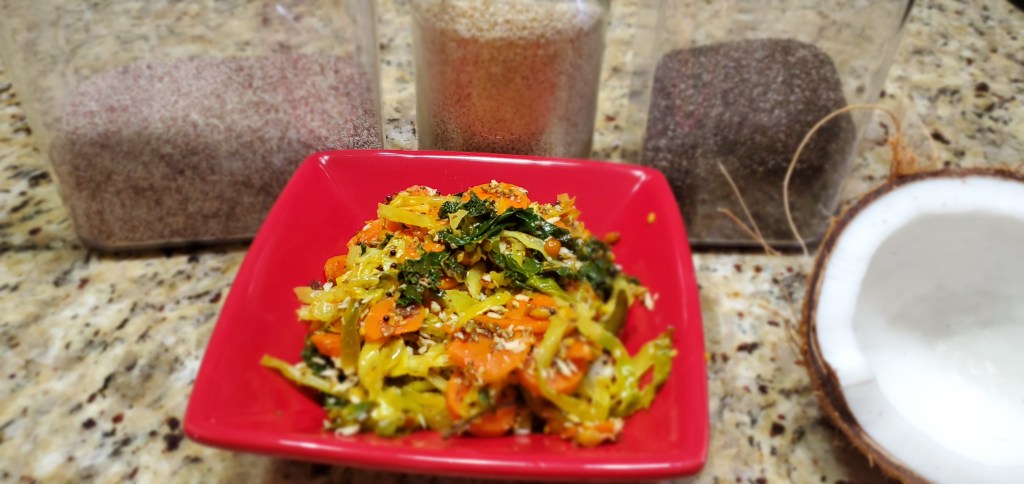
Add mustard seeds, sesames, chia seeds, and finger millets (Ragi flour) to 2 teaspoons of warm oil in a pan/w. Once the mustards start spluttering, add two medium spicy green chillies, and grated ginger. Mix it well, and add carrots sliced thin and cabbage cut into long thin strands. Add salt, turmeric, and put the lid on for 2-3 minutes. At this point, add kale and put the lid on without stirring. In 2 minutes, when the kale turns soft and starts sweating, mix it all well. On a medium flame, leave it on the hob for another two to three minutes. Now, switch off the flame, add a dash of lemon juice and a handful of freshly grated coconut. Put the lid on, and in 5 minutes, your power-packed, healthy quick cabbage curry is ready.
This recipe is rich in vitamins, minerals, fiber, and protein.
You can also deep fry cabbage, as shown here, by sprinkling chickpea and rice flours on the shredded cabbage by moistening with water, salt and chilli powder. Or, try this healthy recipe which I made by accident, running out of time and ideas on a hot summer day.
Employing digital marketing techniques is a step closer to ensuring a safe dining experience post-Covid
Driving on the deserted roads of once a busy Burnet Road in Austin has not been an easy picture to forget and move on. Covid-19 has turned 2020 into one of the worst years both in terms of economic and people loss. According to Reuters, workers in the leisure and hospitality industry have fared worse than most during the pandemic. With countries stopping travel (domestic and international) and issuing stay-home orders resulting in things as they are, the restaurant industry suffered the most.
It’s too late to revive some restaurants and food trucks forced to shut down as soon as the lockdowns were announced. Their inability to swiftly move online and reach out to customers in a contact-free world was the primary reason for this debacle. Survived are those that adapted the relevant technology and made their digital presence prominent. Some companies such as Dominos and Starbucks have posted a marginal profit even in this scenario.
As can be seen from Figure 1, a survey showed that cooking at home was on a high during the initial days of Covid-19, with goods being delivered at the door or with curbside pickups made easier. After a couple of months, when the fun of trying new recipes and home cooking became tedious, restaurants started doing pick-up or take-out and delivery services. This tedious chore of cooking every single day made people realize what they have been missing. Slowly when restaurants started the dining-in facility with social distancing and extra sanitization in place, customers sighed a relief of normality.
Figure 1: Eating habits that were observed pre and post-Covid 19 [1]
With vaccinations in place, these numbers look optimistic. But, unequivocally, the two things that people missed this past year: travel and restaurants.
So, are our restaurants better equipped to handle the demand while still following safety measures? CDC has issued guidelines on the no mask policy this week. Does that mean restaurants can go back to complete normality? Considering the phobias and uncertainty around, we can’t conclude the answer may be a complete yes.
Online interactions have penetrated way deeper into our lives over the past year; consumers prefer virtual interactions, “touchless” contacts– paperless menus, QR codes, online order & payment options, and not to undermine people’s dependence on online reviews! On top of that, retaining customers has become possible only with sales promotion techniques such as coupons, discounts, join-our-app promotions, etc., alongside pampering on their special days and holidays in place. Finding online customers also means tracking and profiling them; personalize and customize their needs with a good user experience (UX) and customer experience (CX), which will embellish a restaurant’s online performance and its CX of the whole process. The bottom line is the businesses that survived the pandemic moved digitally or have been digital.
For a restaurateur, it’s not an easy task to be digital. To manage the digital traffic, feedback and reviews, and to oversee the heavily overcrowded competitive online presence on top of updating menus and maintaining hygiene standards is a tough grind. That’s where the marketing software companies come into the picture, which has been a blessing to the restaurant industry post the Covid-19 pandemic.
With millennials and Gen Z’s preference to working remotely and dining out becoming prominent, restaurants have to move their menus online. Meal kits and dinner box deliveries have proven that people want daily, healthy meals to be delivered home. Online reviews by authentic users and social media influencers available at no cost are the critical decision-making parameters that sway a prospect to a customer. So, with all the backend engineering and the employment it generates, the restaurant industry can now be considered a primary sector. A successful online presence warrants the need for digital marketing: announcing your presence to the digital world.
Digital marketing is a complicated process of targeting and managing prospects, customers, & advocates. Software companies that manage these restaurant profiles ought to have dedicated professionals working 24×7. As customers’ every move and every silence is tracked by the search engines, more so with ever-evolving digital platforms and new algorithms. This tracking provides the data that feeds a restaurant’s digital process. Reaching customers is a good starting point and could be done via email marketing, content management, presence on relevant social media platforms, and website optimization. With consistency in these initial steps, to be on the top pages of search engines is an arduous ultimate step for the success of any online business.
As shown in Table 1, customer adoption of digital technologies to order food is rising. Besides these, generating QR codes helps reach customers without being lost in transit.
I did not do this before the pandemic and have not done it since its onset (%)
I do this somewhat or much less now than I did before the pandemic’s onset (%)
I do this about the same as I did before the pandemic’s onset (%)
I do this some or much more than I did before the pandemic’s onset. (%)
Using the phone to call in an order for pickup
18.5
15.7
24.1
41.7
Buying food from a restaurant’s website
27.8
14.3
19.3
38.6
Using mobile order-ahead to order food from restaurants to eat at home
30.3
13.7
17.9
38.1
Ordering food delivery using aggregators such as Grubhub or UberEats
49.2
11.4
13.1
26.2
Table1: Altered activities related to eating food from restaurants [2]
Digital marketing also incorporates AI (Artificial Intelligence) techniques to gauge customer preferences and trends. This automation helps businesses identify any short-comings in their services and address the pain points of their customers and the restaurants, too, improving the dining experience.
Profiling and targeting prospects require great attention to detail. Is our customer a fitness freak or a vegan or seafood lover? What demographics do they fit? Social media platform statistics show the demographics of their audience: age, gender, location, ethnicity, etc. So, a restaurant’s existence on social media yields dividends in ways that never existed before. Its analytics give precise information about target customers. A digital marketing software company and restaurant business complement each other to be digitally successful and exist in the future.
With software marketing tools in place, digital marketing bridges the gap between the customers and restaurants.
Customer Segmentation involves:
Demographic Segmentation
Psychographic Segmentation
Geographic Segmentation
Behavioral Segmentation
Digital Marketing targets these customers by:
Email Marketing
PPC Marketing
Social Media Marketing
Content Marketing
QR Code Generation
Feedback Management
App Marketing
Personalized Marketing
SEO Marketing
With the changes in people’s lifestyles, the restaurant industry must embrace digital technologies more so post-pandemic. Consequently, accessibility to design and procure food by the touch of a finger should be ubiquitous. The recent AI trends enabling this digital marketing revolution should help pave the way for the future of any restaurant business, thus making it immune to any future pandemics.



 Across three continents!!